
「醫師,音波和電波,哪一個比較好?」
這是抗老療程最常被問的問題之一。音波和電波都是用熱刺激膠原蛋白、改善皮膚鬆弛的非侵入式療程,但加熱的方式和作用的位置不同。沒有哪一個「絕對比較好」,而是看您的需求適合哪一種。
先說結論
沒有哪一個「絕對比較好」。音波把熱聚焦在固定深度,電波是大範圍均勻加熱;研究中兩者效果相近,重點是哪一個適合您的狀況。⁶
一張表看懂音波和電波
| 音波(聚焦超音波) | 電波(radiofrequency) | |
|---|---|---|
| 能量 | 超音波 | 高頻電流 |
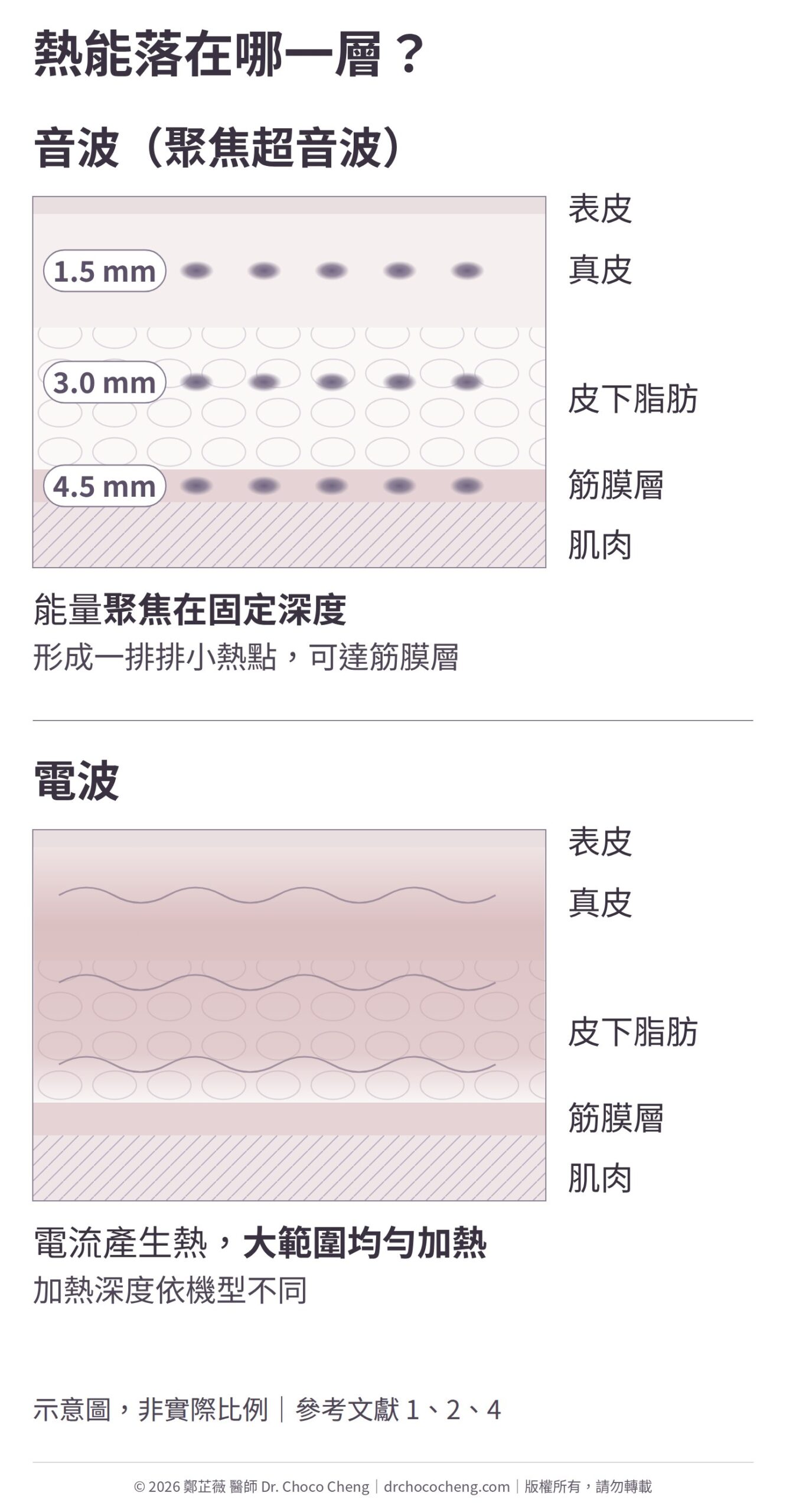
| 加熱方式 | 能量聚焦在特定深度,形成許多微小的熱點¹ ² | 電流通過組織時,因組織的阻抗產生熱,屬於大範圍、體積式的加熱² ³ |
| 作用深度 | 固定的聚焦深度,如 1.5、3.0、4.5 毫米,可達筋膜層¹ | 依機型不同;單極電波可以加熱到較深、較大範圍的組織⁴ |
| 溫度 | 聚焦點約 60 到 70°C¹ ² | 依設定不同,膠原蛋白變性約需 55 到 70°C⁴ |
| 恢復期 | 通常不需要 | 通常不需要 |
資料來源:參考文獻 1–4
音波像縫衣服
一針一針,落在固定的深度,包括外科拉皮會處理的筋膜層。¹ ⁵
電波像燙衣服
熨斗壓過去,一整片同時變熱,是大範圍的加熱。² ³
研究怎麼比較兩者?
一項隨機分派、半臉對照的研究,讓 20 位受試者一側臉接受單極電波、另一側接受聚焦超音波,追蹤 6 個月。結果發現:兩側都有明顯改善,而且兩側在鬆弛改善、滿意度與副作用上都沒有差別。⁶
隨機分派
半臉對照
兩側都有
明顯改善
鬆弛、滿意度
副作用無差別
也就是說,兩種療程都有研究支持,選擇的重點不在於哪一個比較強,而在於哪一個比較適合您的狀況。
選擇的重點不在哪一個比較強,
而在哪一個比較適合您。
常見問題
Q 音波和電波,哪一個比較痛?
疼痛感因人、因部位、因機型與設定而不同。研究中,音波拉提的平均疼痛約為中等程度(10 分中約 4 到 5 分)。⁷ 詳見〈音波拉提會痛嗎?有哪些副作用?〉。
Q 臉比較瘦的人適合做音波嗎?
臉部脂肪較少的人,需要特別注意治療的深度與能量。有報告指出,不當或過量的聚焦超音波,可能造成臉部脂肪減少、看起來凹陷。² ⁸ 治療前請讓醫師評估。
Q 做過玻尿酸或其他填充物,可以做音波或電波嗎?
研究顯示,音波與填充物合併治療的安全性,和單獨治療相近。⁹ 但仍需告訴醫師您過去注射的部位與材質,由醫師評估。
重點整理
- 音波和電波都是用熱刺激膠原蛋白的非侵入式療程。
- 音波把能量聚焦在特定深度,可以作用到筋膜層;電波是大範圍、均勻的加熱。
- 一項半臉對照研究發現,兩者的效果與副作用沒有明顯差別。
- 選擇的重點是適不適合您的狀況。
音波或電波哪一個適合您,需要經過醫師面診評估。
本文僅供衛教參考,不能取代醫師面診。療程是否適合、效果與風險,皆需經醫師評估說明。
有問題想詢問,歡迎加入 LINE 官方帳號;更多鄭芷薇醫師資訊在 Instagram。
參考文獻
- Fabi SG. Noninvasive skin tightening: focus on new ultrasound techniques. Clin Cosmet Investig Dermatol. 2015;8:47-52. doi:10.2147/CCID.S69118
- Park JY, Lin F, Suwanchinda A, et al. Customized treatment using microfocused ultrasound with visualization for optimized patient outcomes: a review of skin-tightening energy technologies and a pan-Asian adaptation of the expert panel’s gold standard consensus. J Clin Aesthet Dermatol. 2021;14(5):E70-E79.
- Sachdev M, Hameed S, Mysore V. Nonablative lasers and nonlaser systems in dermatology: current status. Indian J Dermatol Venereol Leprol. 2011;77(3):380-388. doi:10.4103/0378-6323.79733
- Zhang B, Tan X, Zhang Q, Wu M. The landscape of radiofrequency technology for skin rejuvenation. Health Sci Rep. 2025;9(1):e71575. doi:10.1002/hsr2.71575
- White WM, Makin IRS, Barthe PG, Slayton MH, Gliklich RE. Selective creation of thermal injury zones in the superficial musculoaponeurotic system using intense ultrasound therapy: a new target for noninvasive facial rejuvenation. Arch Facial Plast Surg. 2007;9(1):22-29. doi:10.1001/archfaci.9.1.22
- Alhaddad M, Wu DC, Bolton J, et al. A randomized, split-face, evaluator-blind clinical trial comparing monopolar radiofrequency versus microfocused ultrasound with visualization for lifting and tightening of the face and upper neck. Dermatol Surg. 2019;45(1):131-139. doi:10.1097/DSS.0000000000001653
- Amiri M, Ajasllari G, Llane A, et al. Microfocused ultrasound with visualization (MFU-V) effectiveness and safety: a systematic review and meta-analysis. Aesthet Surg J. 2025;45(3):NP86-NP94. doi:10.1093/asj/sjae228
- Humphrey VS, Rambhia PH, Gmyrek R, Chapas A. Microfocused ultrasound with visualization: a systematic review of adverse events and risk of subsequent facelift compromise. Dermatol Surg. 2025;51(4):424-429. doi:10.1097/DSS.0000000000004510
- Fabi SG, Goldman MP, Mills DC, et al. Combining microfocused ultrasound with botulinum toxin and temporary and semi-permanent dermal fillers: safety and current use. Dermatol Surg. 2016;42(Suppl 2):S168-S176. doi:10.1097/DSS.0000000000000751